In the last decades, 2D studies in axial symmetry have been carried out to explore in detail the cooling of strongly magnetized neutron stars and the interplay between the thermal and magnetic evolution (Pons, Miralles & Geppert 2009; Viganò, Rea, Pons et al. 2013). The first attempts to extend this to 3D were limited to the magnetic evolution without taking into account the thermal one, which increases substantially the computational load (Gourgouliatos & Cumming 2014, Gougouliatos et al. 2016; Bansgrove, Levin & Beloborodov 2018) or included it in a very schematic fashion (Igoshev et al. 2020, De Grandis et al. 2020). On the other hand, long standing collaborators of the group developed the state-of-the-art of 2D numerical simulations, e.g. Viganò et al. 2013, 2021).
The 3D magneto-thermal evolution code MATINS (Dehman et al 2023, Ascenzi et al 2024) closes this gap by building a complete self consistent and detailed 3D model. This is crucial since (i) magnetic field evolution is an important ingredient for pulsar population synthesis as magnetic field changes affect the stellar rotational properties, which are the key ingredient to extract pulsar properties at birth from observations, (ii) the burst activity of magnetars is driven by magnetic field evolution and the release of accumulated crustal stresses (Pons & Rea 2012; Beloborodov & Levin 2014; Li et al. 2016); modelling the magneto-thermal evolution is thus needed to predict flaring rates. For realistic predictions, 3D models are necessary to properly model current flows over the entire neutron star surface and incorporate realistic, non-axisymmetric field geometries. This new allows us to determine cooling curves to be constrained observationally, and will be used to predict magnetar flaring rate as a function of age and magnetic strength/geometry at birth.
Moreover, we developed new models of NS thermal evolution over short time scales, which requires a more accurate treatment of the outermost NS layers (KOvlakas, De Grandis & Rea 2025). We used this to model magnetar outbursts, a type of activity connected to the appearance of thermal features on NS surfaces (De Grandis, Rea et al. 2025)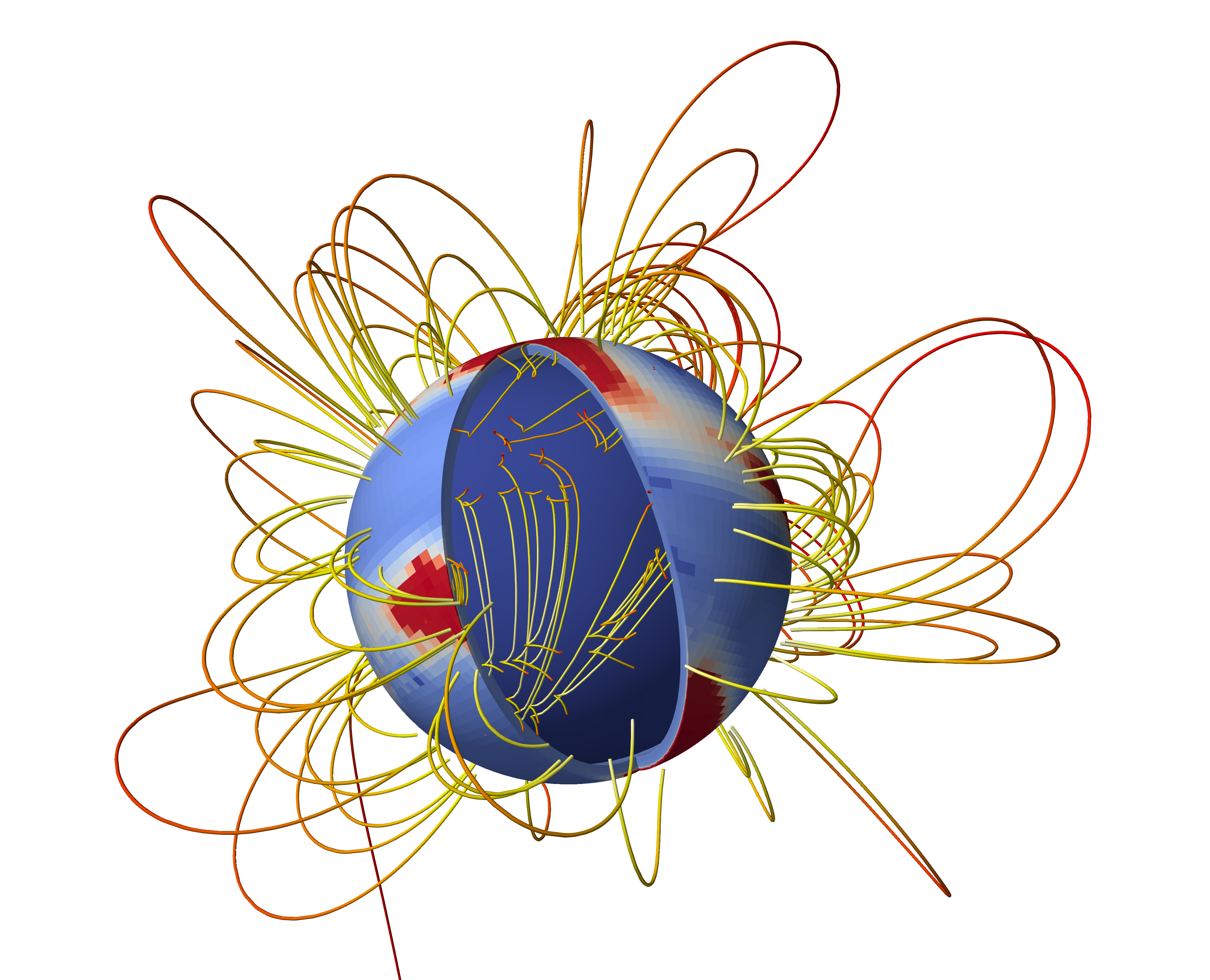
Example of tangled magnetic field inside the crust and in the lower magnetosphere of a NS (lines) and the corresponding crustal temperature (colors) computed with MATINS.