Our activities focus mainly on the study of the multi-band emission of magnetars, the strongest magnetised neutron stars.
Using approved programs for both ground-based telescopes (e.g. Parkes, GBT, ATCA) and orbiting high-energy satellites (e.g. NICER, Swift, XMM-Newton, NuSTAR, Chandra), observations of magnetars are performed as soon as they experience so-called X-ray outbursts. These episodes manifest as order of magnitude increases in the flux of the persistent X-ray emission and are typically pinpointed following the detection of short X-ray bursts - a hallmark of these peculiar sources - from all-sky monitors. These outbursts provide a unique test bed to investigate the emission physics of these sources. Observational studies focus in particular on their temporal and spectral properties and their evolution as they recover the quiescent state. Such studies make it possible to map the thermal emission on the stellar surface, understand the contribution of magnetospheric processes to the observed emission, establish the physical conditions that allow the pulsed and bursting radio emission to be triggered, and ultimately estimate key source properties such as the characteristic age, the dipole magnetic field at the surface, and the rotational energy loss rate.
An additional ongoing project involves the development of algorithms and pipelines to search for transient events and periodic or aperiodic sources in the data of several publicly available multi-band catalogues. The ultimate goal of this project is to increase the number of known magnetars through the discovery of outburst activities that possibly passed unnoticed in the past and/or the onset of pulsed emission (typically at periods of the order of a second or longer). In recent years, a few research teams have begun to apply such algorithms to data of a small number of X-ray satellites. Our work aims to systematically extend these searches to high-energy data collected by other satellites (including gamma-ray satellites) as well as data at other wavelengths. State-of-the-art pipelines will be adapted so as to cope with the different formats of the data produced by the different telescopes. The potential for new discoveries is extremely promising.
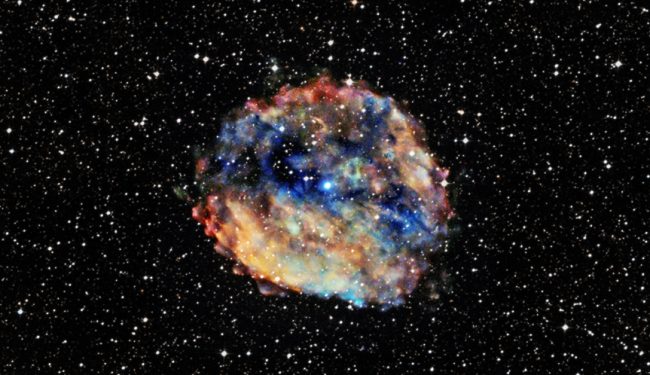
The peculiar slowly rotating magnetar at the center of the supernova remnant RCW 103. Credit: X-ray: NASA/CXC/University of Amsterdam/N.Rea et al; Optical: DSS