The neutron star population is dominated by radio pulsars. However in the last decades, several extreme and puzzling subclasses of neutron stars have been discovered: Anomalous X-ray Pulsars (AXPs), Soft Gamma Repeaters (SGRs), Rotating Radio Transients (RRAT), X-ray Dim Isolated Neutron stars (XINSs), Central Compact Objects (CCOs) as well as the more common X-ray binary neutron stars accreting material from a low-mass or high-mass companion star. In particular, despite being governed by a single equation of state, the neutron star zoo manifests itself as a multifaceted population: some neutron stars are observed to emit only in radio, others seem to emit only high- energy radiation in the form of X-rays and gamma rays. Some show continuous activity, while others are capable of emitting sudden powerful transients. This puzzling variety of observational properties is still largely unexplained. Additionally, we know that neutron stars are the compact remnants of massive stars that end their lives in Core Collapse Supernovae. To accommodate limits of the death rate of such massive stars in our Galaxy (around 1-3 per century), different neutron star classes are likely related and can be linked through evolution. Despite observations being plentiful, we are far from understanding connections between these different classes and a unified scenario.
Therefore, one of the main objectives of population synthesis studies is to reconstruct, from a statistical point of view, the unknown distributions of physical properties that characterise the initial population. The general approach is to use the present-day observed properties of neutron stars, together with some assumptions and theoretical models about their time evolution, to reconstruct the birth distribution of physical properties such as their natal kick velocities, spin periods and magnetic field strengths (see e.g., Faucher-Giguère and Kaspi, 2006, Gullón et al., 2015, Ciéslar et al., 2020). We are developing ML-Poppyns (Ronchi et al., 2021, Graber et al., 2024, Pardo Araujo et al. 2025), a population-synthesis framework where different neutron star populations can be simulated starting from various initial conditions in terms of birth positions, velocities, spin periods and magnetic field strengths. Their initial properties are then evolved in time until the present day. In particular, we model the motion of the neutron stars in the Galaxy, the magnetic field decay, the secular spin-down evolution due to the emission of electromagnetic radiation and magnetospheric torques and their radiative emission at different electromagnetic wavelengths: radio, X-rays and gamma rays.
Finally, in order to perform a comparison with observed data, we need to account for observational limitations. This is incorporated by applying filters and selection biases that are able to mimic the limited sensitivity of real surveys. In this way, mock populations can be constructed and compared with the real observed populations at different wavelengths. The comparison with observation is challenging as our parameter space is highly multi-dimensional. However, this comparison is necessary to constrains theoretical models used in the simulations and distributions of birth properties of the population. For this purpose, we take advantage of the power of machine learning, especially an approach called Simulation-Based Inference (SBI) (see e.g., Cranmer et al. 2020). For complex and computationally expensive simulations, the likelihood function cannot be computed explicitly, and SBI overcomes this limitation by training neural networks (neural density estimators) on simulated data to learn a mapping between model parameters and simulated observables and reconstruct an approximation of the posterior distribution of the model parameters. To process and compress the information contained in the simulated data we adopt convolutional neural networks. These neural networks are able to learn complex patterns and extract information from the multi-dimensional data provided by our simulations and have the power of generalising to unseen data samples, such as the true observed neutron star population. In this way, we aim to provide a framework to interpret the features of entire Galactic neutron star population in an omni-comprehensive way.
ML-Poppyns will be the first population-synthesis framework to incorporate information coming from the multi-wavelength observations of neutron stars, from radio to X-rays and gamma rays. This will allow us to better constrain the birth properties of the observed Galactic population of neutron stars and to shed light on the origin of their different sub-classes in a unified scenario.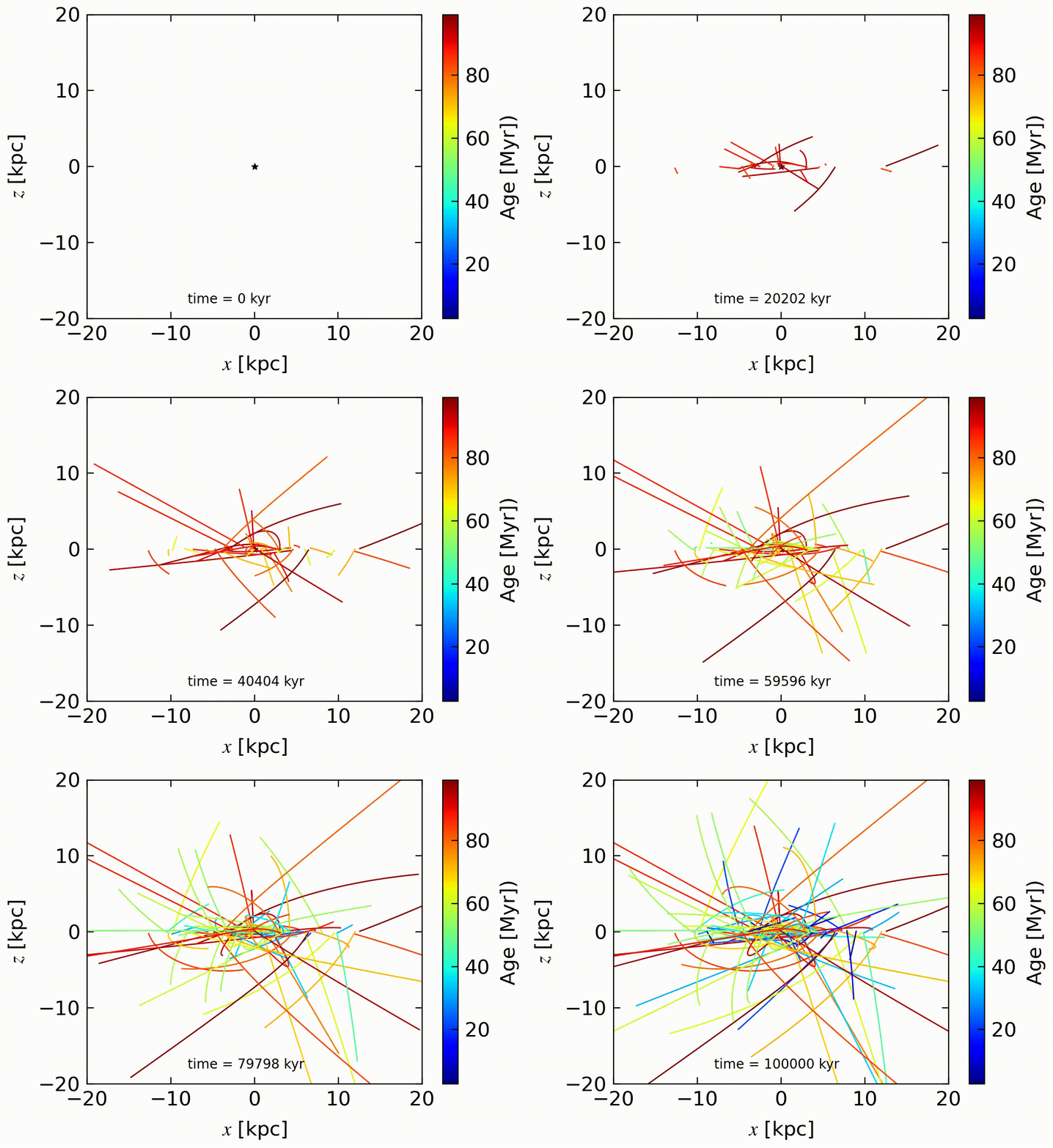
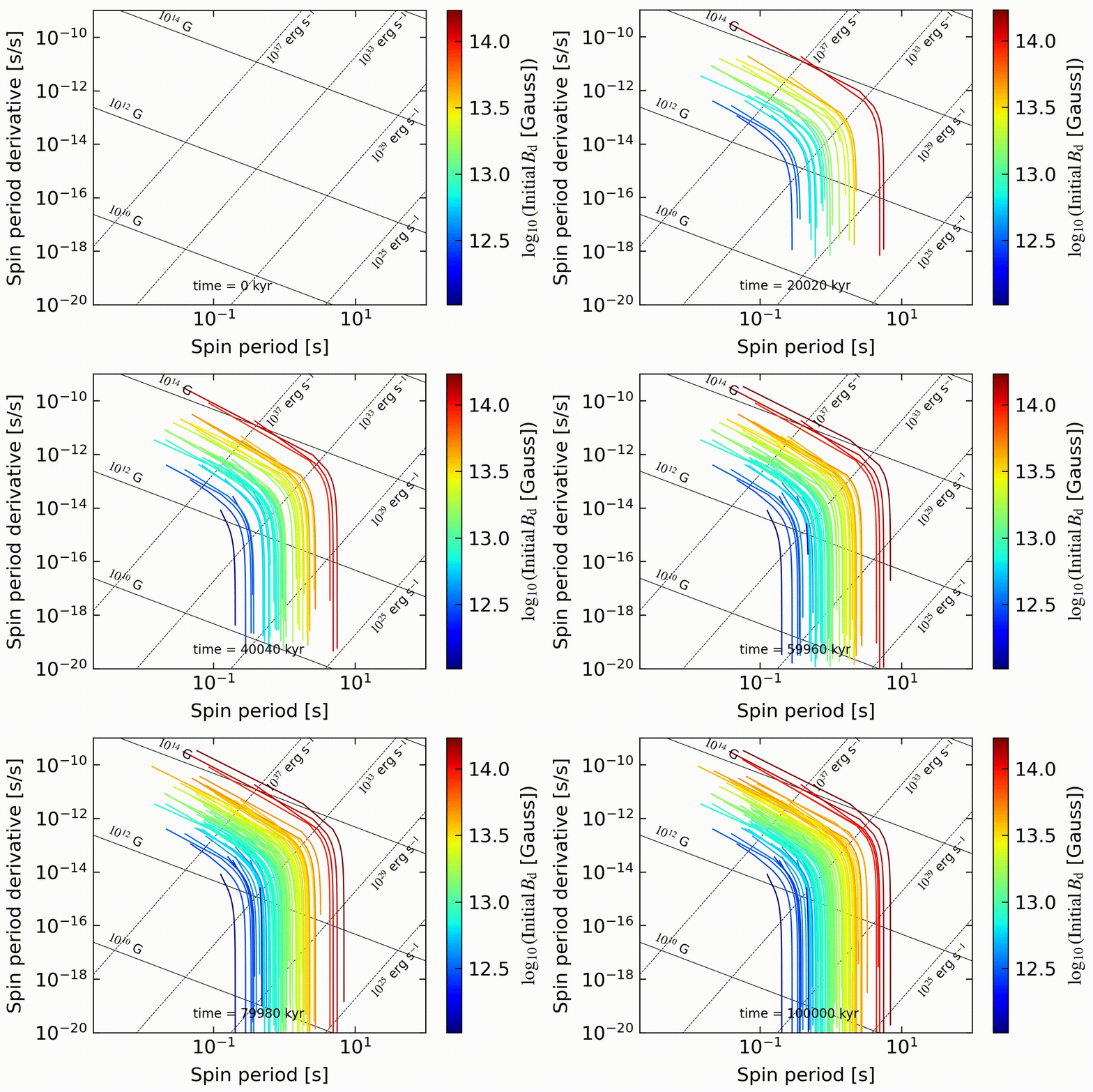
Dynamical (left) and magneto-rotational (right) evolution of neutron stars.